Members should remember our walk, led by Pat Symms, around Tarporley High Street in September, and followed by supper in the Swan Hunt room. This was a different start to our season and well enjoyed. However Pat only managed to take us around the top end of the street before darkness fell. So for Christmas we invited Pat to give us a virtual tour of the lower High Street in the comfort of the Village Hall. Having lived in Tarporley for 28 years, I'm still learning about the village, and in particular how, even in recent times, Tarporley was so self-sufficient.
Click on lower High St to see photos
And as it was Christmas, our 'post-walk' refreshments were mince pies, stollen etc.
Thursday, 7 March 2019

Monday, 3 December 2018
1000 years of Cheshire History 22nd November
The speaker this meeting was Bob Welch our treasurer. Bob gave us a whistle stop tour of the history of Cheshire between the arrival of the Romans and medieval times. The early history of Cheshire was effectively the history of Chester. And Chester's history reflected the power struggles and battles of the English crown and the Welsh princes. Bob also gave us some insight into the development of the Church and local life.
We look forward to part 2 bringing us up to modern times.
We look forward to part 2 bringing us up to modern times.
Hawkstone Park 25th October
It is always great when you have a speaker who knows and feels passionate about their subject and is also a good communicator. Barry Fewster met all those criteria.
Barry told us about Hawkstone Park, its history, the story of the Hill family, and the Park's development into a magical garden of follies and attractions, all set in craggy countryside just south of Whitchurch. It is still open to visitors and is well worth a visit.
See http://www.hawkstoneparkfollies.co.uk/
Barry told us about Hawkstone Park, its history, the story of the Hill family, and the Park's development into a magical garden of follies and attractions, all set in craggy countryside just south of Whitchurch. It is still open to visitors and is well worth a visit.
See http://www.hawkstoneparkfollies.co.uk/
Saturday, 20 October 2018
Tarporley High Street 27th September 2018
We started our 2018/9 season with a bit of a difference. Rather than our normal meeting and talk in Tiverton, we had a tour of Tarporley High Street. Pat Symms was our guide and on a rather dull late summer evening, with the light just starting to fade, Pat took a party of some 30 brave members on a fascinating insight into the buildings and history of the village. We started in the Market Court by the Swan, walked up to Burton Square, and finished by the Manor House. What we discovered was that, despite some new developments, many of the buildings in the High Street haven't changed. What has changed is the use of the buildings and how businesses have moved on from a variety of local trades, many associated with Tarporley's connection with horses, such as blacksmiths and saddlers, to today's shops serving 21st C needs. And even today's shops are changing from year to year.
We finished our walk with a supper in the Hunt Room, directly above the Market Court, with Pat giving us some of the history of the room and the Tarporley Hunt.
Feedback suggests that this was a very successful evening. Many thanks to Pat for organising this.
We finished our walk with a supper in the Hunt Room, directly above the Market Court, with Pat giving us some of the history of the room and the Tarporley Hunt.
Feedback suggests that this was a very successful evening. Many thanks to Pat for organising this.
Sunday, 29 July 2018
Visit to Norton Priory, Runcorn, on 22nd June
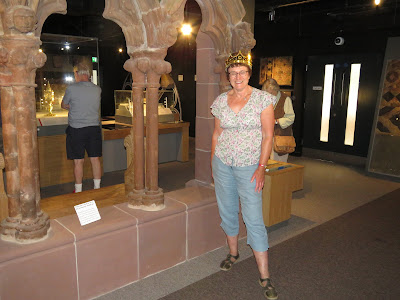
A small band of intrepid members braved the particularly warm weather to visit this historic site. Norton Priory was founded in the 11th century and became a major monastic site until the Dissolution. It slowly fell into ruin but more recently it has become the most excavated monastic site in Europe. Norton Priory has benefited from significant funding and now has an excellent Visitor Centre and Museum. Assembling after coffee, we were given a guided tour around the site and museum. Members then had a chance to explore on their own and later to enjoy lunch.
See http://nortonpriory.org/ for more information.
Some us then walked over to the 2.5 acre Georgian walled gardens. These excellent gardens were unfortunately suffering (like us) from some some exceptionally hot and dry weather. We need to go back in a 'normal' summer.




See http://nortonpriory.org/ for more information.
Some us then walked over to the 2.5 acre Georgian walled gardens. These excellent gardens were unfortunately suffering (like us) from some some exceptionally hot and dry weather. We need to go back in a 'normal' summer.


Monday, 4 June 2018
AGM 24th May
The Society held its AGM at Tiverton Village Hall on 24th May.
Some 18 members attended.
It was reported that we now had 48 members and finances were healthy. We had some £1894 in reserves.
The following officers were elected.
Tom Platt Chair
Trish Welch Vice-chair
Bob Welch Treasurer
Paul Bujac Secretary
Items discussed included next year's programme and the Society's Privacy Policy.
Details can be found in the draft minutes; follow Draft minutes
The meeting was followed by an open discussion on how things, particularly communications, had changed in our life times.
Some 18 members attended.
It was reported that we now had 48 members and finances were healthy. We had some £1894 in reserves.
The following officers were elected.
Tom Platt Chair
Trish Welch Vice-chair
Bob Welch Treasurer
Paul Bujac Secretary
Items discussed included next year's programme and the Society's Privacy Policy.
Details can be found in the draft minutes; follow Draft minutes
The meeting was followed by an open discussion on how things, particularly communications, had changed in our life times.
Hampton House School 26th April
Members were given an insight into life in an English Prep school in the late 50's and early 60's when Andrew Wheeler talked about his time as a boarder at Hampton House School. This school moved from Chester post war into Gardenhurst, a gentlemen's residence, and then closed in the 60's. The building was then demolished and site developed for housing and for the local Deeside Ramblers hockey club.
Andrew gave a personal view of being a young boarder, away from home, and, in particular, his recollections of the staff and some scandal.
Andrew gave a personal view of being a young boarder, away from home, and, in particular, his recollections of the staff and some scandal.
Wednesday, 4 April 2018
Victoriana 22nd March 2018
Our speaker in March, Sally French-Greenslade, took us back over a century to a Victorian living room. Using a wide range of artefacts, Sally gave us a glimpse of life when Queen Victoria was on the throne. Chamber candlesticks showed us the way to bed before electricity appeared; Victorian face shields in front of the coal fire kept the ladies complexions pale before central heating arrived; embroidered samplers showed off the ladies' craft skills; many other decorative and practical items illustrated the domestic life of the times.
Sunday, 25 February 2018
100 years of trains to Audlem 22nd February
Jeremy Nichols came to tell us about the Nantwich and Market Drayton Railway. This railway was opened in 1863 and provided part of the link between Crewe and the Midlands for the GWR. Although passenger traffic was modest, the line was an important freight route. However as part of the Beeching rationalisation plan, the line closed to passenger traffic in 1963 (just 100 years of service) and to freight traffic in 1967.
Jeremy grew up in Nantwich within sight of this railway, and he retrieved many old documents from the derelict Audlem station before it was demolished. He used many of these documents, eg receipts for goods carried, to show how the railway was managed and, intriguingly, how the railway changed the rural life in South Cheshire. Jeremy also showed us photographs both from the railway's heyday and from the final years before closure. The talk brought back memories for many members, who wherever they were at the time, had been brought with steam travel.
Jeremy grew up in Nantwich within sight of this railway, and he retrieved many old documents from the derelict Audlem station before it was demolished. He used many of these documents, eg receipts for goods carried, to show how the railway was managed and, intriguingly, how the railway changed the rural life in South Cheshire. Jeremy also showed us photographs both from the railway's heyday and from the final years before closure. The talk brought back memories for many members, who wherever they were at the time, had been brought with steam travel.
History through Metal Detecting 25th January
Martin Tobbit, who is a
member of the Crewe and Nantwich Metal Detecting Society, gave a very personal talk on metal detecting. He explained how he became fascinated with how metal detecting can be used to discover the past. Briefly introducing his modern detection equipment, he told us how he has been searching the local fields, and what he had unearthed. Perhaps the most memorable part of Martin's talk, was when he passed around some of his finds. It's not every evening that you handle a neolithic arrow head and a Roman coin.
Christmas Social 21st December
The run up to Christmas is always a busy time so we had decided not to invite a speaker. Instead we had an enjoyable 'homespun' meeting when members brought along and described a few historic personal items. It's amazing what people have tucked away at home. The evening finished with mince pies, stollen, and a topical quiz.
Monday, 11 December 2017
The Canal Duke 23rd November
The Society welcomed back one of our favourite speakers, local historian, Bernard Dennis. Bernard talked last time about Sir Thomas Egerton, a local lad who made good in high offices of state under Queen Elizabeth and King James 1. Tonight's talk continued the Egerton saga with details of the life of one of his descendants, Francis Egerton, the Duke of Bridgwater. Francis Egerton was known as the 'Canal Duke' because he was one of the men instrumental in launching the canal age. The Duke, who had inherited lands including Tatton Park and coal mines at Worsley, recognised the canals as an effective way of transporting goods, particularly coal, to and from the industrial areas. His fortunes, land and good contacts, allowed him to the build the Bridgewater Canal linking Worsley to the Mersey.
Tuesday, 7 November 2017
Bank Notes 26th October
Bob Welch writes
In his talk which was both informative and amusing Chis Leather told us of the German Nazi Government's plan to try and destabilize the British economy by forging and then releasing millions of pounds worth of British Bank Notes.He explained in detail how they went about organising this, how they recruited people with the relevant skills, including criminal forgers from prisons. He explained the lengths that they had to go to to get the right sort of paper, ink etc. It was not an easy job but in they end they succeeded and many millions of notes were released, manly for the purchase of gold, jewels etc of for payments of bribes to agents and contacts in other countries. By the end of the War most of the participants managed to escape from Nazi control and went on with their lives as before the War. One Officer was executed for War Crimes but the last actual forger didn't die until January 2017. Chris had with him examples of the forged notes which were interesting in themselves. A good talk.
In his talk which was both informative and amusing Chis Leather told us of the German Nazi Government's plan to try and destabilize the British economy by forging and then releasing millions of pounds worth of British Bank Notes.He explained in detail how they went about organising this, how they recruited people with the relevant skills, including criminal forgers from prisons. He explained the lengths that they had to go to to get the right sort of paper, ink etc. It was not an easy job but in they end they succeeded and many millions of notes were released, manly for the purchase of gold, jewels etc of for payments of bribes to agents and contacts in other countries. By the end of the War most of the participants managed to escape from Nazi control and went on with their lives as before the War. One Officer was executed for War Crimes but the last actual forger didn't die until January 2017. Chris had with him examples of the forged notes which were interesting in themselves. A good talk.
Cheshire Landowners 28th September
Our Chairman Doug Haynes started our new season by giving the first talk on 'Cheshire Landowners through the ages'.
Sunday, 16 July 2017
Anderton Lift Boat trip 22nd June
Some 18 members visited a local feat of Victorian engineering, the Anderton Boat Lift. (Lift website) This lift built in 1875, but recently restored, allowed laden canal boats to be moved to and from the River Weaver below and the Trent and Mersey canal above. The river gave good access to the Mersey and Liverpool; the canal gave good access to the Cheshire salt towns and the Potteries. The feedback from members was that this was a very successful and enjoyable outing with lunch, then a river cruise to Northwich, and finally a ride up the lift itself at the end.


Pictures Cathy Peel and Paul Bujac


Pictures Cathy Peel and Paul Bujac
AGM 25th May
The Society held its AGM on 25th May. Bob Welch was in the chair and some 18 other members attended. Formal minutes will be published later but the main points to note include:
- Anita Langford (Treasurer) noted that income comfortably exceeded expenditure and the Society had some £2015 in the bank account
- Therefore it was decided to hold the membership fee at £10
- Anita is stepping down as Treasurer as she is taking over the treasurer's role for the Tarporley and District U3A. Bob thanked her for all her hard work over the past 2/3 years.
- Unfortunately there had been no volunteers for this treasurer vacancy, so the following were proposed and elected for the committee:
Doug Haynes Chair
Bob Welch Treasurer
Paul Bujac Secretary - A full programme has been arranged for next year. Thanks to Trish Welch for all her work. (Trish is also standing down).
- The summer outing will be to the Anderton Boat Lift on 22nd June.
Thursday, 25 May 2017
The Liverpool Cow Keepers 27th April
David Joy gave us a
personal view of a side of life which has now disappeared. He told us about the
dairy business in Liverpool, that started in the days before
refrigeration, when families kept small
herds of cows within the city to provide fresh milk to the local growing population. These family
businesses not only looked after the cows but also run the local milk rounds up
until the middle of the last century when the large national dairy companies
took over. David was a member of one of those family dairies and, through his
talks and books, he is keen to keep that history alive. He has a website http://www.davejoy-author.com/ that
shows his passion and interest for this past
way of life.
The Mersey Gateway project 23rd March
This talk was more
about history in the making, rather than past history, when Barrie Davidson, a
volunteer with the Mersey Gateway Project told us about the new Mersey bridge.
Construction on this bridge, linking Widnes and Runcorn, started in 2014 with
completion planned for this autumn. It is a major project with the challenges
both of building the bridge structure and of constructing and modifying all the
approach roads. More details can be found on http://www.merseygateway.co.uk/
Friday, 28 April 2017
Doris spoils the night 23 February
Storm Doris hit the local area in the afternoon, uprooting trees and taking out the power locally. With no electricity in Tiverton, we unfortunately had to cancel the meeting (Caroline Hamilton's talk on the Hammond School).
Sunday, 12 February 2017
The London to Holyhead Mail Coach Route 26th January
Attendance was very good on a cold January night. Bob Welch notes:
During a very entertaining Talk given by David
Waller of the Northop Heritage Group he explained how the very earliest
"Mail" system started during the reign of Henry V111 to take official
documents to various parts of England and Wales over a number of dedicated
routes including the London Holyhead route which travelled through Tarporley
and Chester on its way to the port of Holyhead. Various Postmasters were
appointed a stages along the route who had to supply the horses for the Royal
Messenger and a Postboy to show him the way and return the horses from the next
staging post. The Post Masters were often Innkeepers. By the time of Charles 1
demand was such from the public that the service was made available to all, or
at least those who could afford to pay.
In 1720, one Ralph
Allen from Bath saw an opportunity and with the help (influence and money) from
his father-in-law set up a nationwide postal service carrying the mail on
behalf of the Post Office. He had a very lucrative contract for doing this and
by the time of his death in 1764 had made a lot of money.
The next stage of
development came with John Palmer, also from Bath, who persuaded the then
Chancellor William Pitt that it would be a good idea to carry the Mail by
stagecoach. Safer also as the Postboys were always at risk of attack. Although
the Post Office were against the idea, Palmer went ahead on his own and
developed a network of routes to carry the Mail by specially designed coaches.
The London Holyhead route was one such. In 1785 the Post agreed to take over
the running of the service. Each Mail coach had priority on the route, paid no
Turnpike dues and the Mail was protected by an armed Royal Mail Guard. Mail
Coaches left the Swan with Two Necks Inn in London promptly at 8.00pm every
evening and arrived at Holyhead 45.5 hours later. Nantwich and Tarporley were
stopping points for the team of four horses to be changed as was Chester but
there the stop included a meal break. Over time the route was changed to miss
out the dangerous crossing of the River Conway and the mountainous North Wales coast
to an easier one via Shrewsbury thus the Mail coaches no longer came through
Cheshire. It also shortened the journey to about 25 hours.
By the 1840s the
Railways had been built and the horsedrawn Mail Coaches were consigned to
history.
Subscribe to:
Posts (Atom)